
Real-World JSON Parsing in Java (Complete Guide)
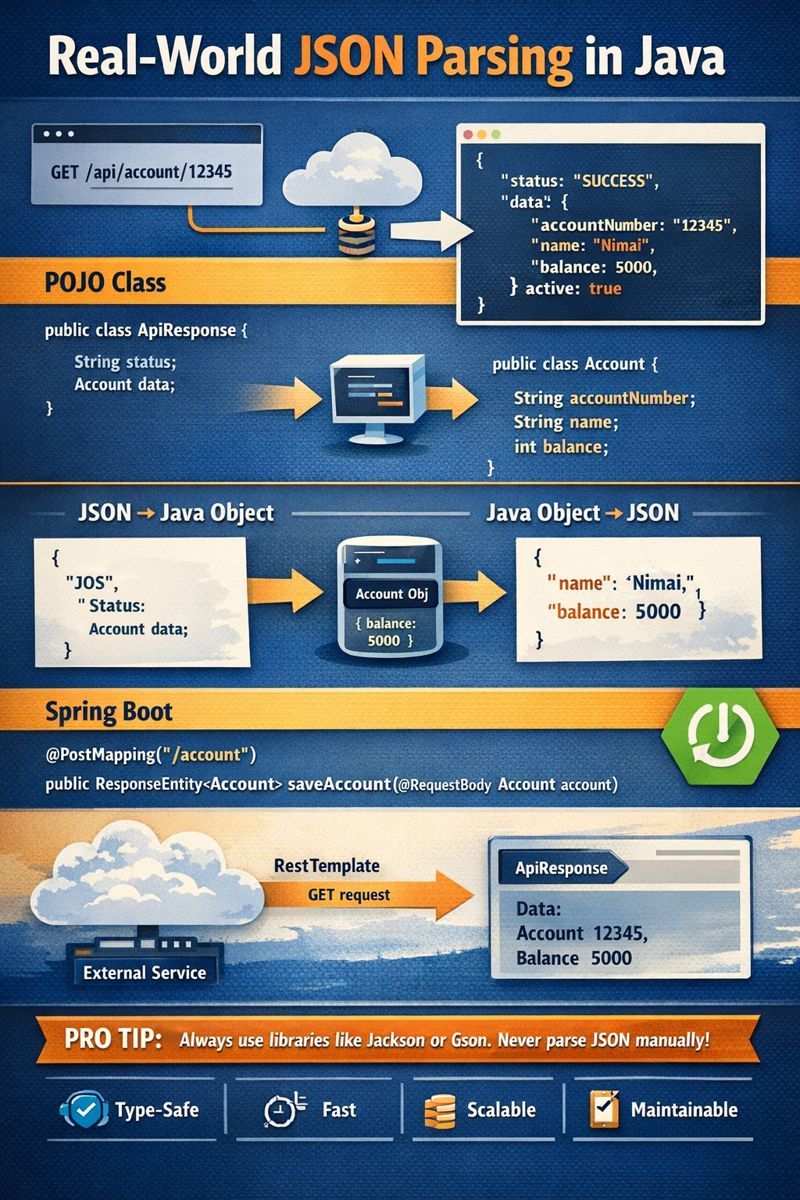
JSON (JavaScript Object Notation) is the most widely used data format for communication between systems. Almost every modern application — banking, e-commerce, payments, social media — uses JSON to exchange data.
In this blog, we will understand:
- What JSON parsing really means in real systems
- How Java handles JSON in production
- A complete real-world example
- Common mistakes and best practices
What is JSON Parsing?
JSON parsing means converting:
- JSON → Java Object (Deserialization)
- Java Object → JSON (Serialization)
Example:
{"name":"Nimai","balance":5000}
Becomes:
Account account = new Account("Nimai", 5000);
Real-World Scenario: Banking API
Imagine a banking system (like SBI or HDFC).
A frontend app calls backend:
GET /api/account/12345
Backend responds:
{
  "status": "SUCCESS",
  "timestamp": "2026-01-29T10:15:30",
  "data": {
    "accountNumber": "12345",
    "name": "Nimai",
    "balance": 5000,
    "currency": "INR",
    "active": true
  }
}
This is a realistic enterprise JSON structure.
Step 1: Create Domain Classes
public class ApiResponse {
    private String status;
    private String timestamp;
    private Account data;
}

public class Account {
    private String accountNumber;
    private String name;
    private int balance;
    private String currency;
    private boolean active;
}
These classes represent business objects.
Step 2: JSON → Object (Deserialization)
ObjectMapper mapper = new ObjectMapper();

ApiResponse response =
    mapper.readValue(jsonString, ApiResponse.class);

System.out.println(response.getStatus());
System.out.println(response.getData().getBalance());
Now you are working with strongly typed Java objects, not strings.
Step 3: Object → JSON (Serialization)
When sending response back:
Account acc = new Account();
acc.setName("Nimai");
acc.setBalance(5000);

String json = mapper.writeValueAsString(acc);
System.out.println(json);
Output:
{"accountNumber":null,"name":"Nimai","balance":5000,"currency":null,"active":false}
Real Spring Boot Flow (Actual Production)
Controller
@PostMapping("/account")
public ResponseEntity<Account> saveAccount(
        @RequestBody Account account) {

    return ResponseEntity.ok(account);
}
What happens internally?
- JSON comes from HTTP request
- Jackson converts it to
Account - You directly use Java object
- Response is again converted to JSON
You never write parsing logic.
Calling External API (Microservices)
In microservices, one service consumes another:
RestTemplate restTemplate = new RestTemplate();

ApiResponse response =
 restTemplate.getForObject(
   "https://bank.com/api/account/12345",
   ApiResponse.class);

System.out.println(response.getData().getName());
This is true real-world usage.
Handling Unknown Fields
Real APIs change often.
@JsonIgnoreProperties(ignoreUnknown = true)
public class Account {
   ...
}
Prevents crash if new fields appear.
Custom Field Mapping
JSON:
{"acc_no":"12345"}
Java:
@JsonProperty("acc_no")
private String accountNumber;
Date Handling
@JsonFormat(pattern = "yyyy-MM-dd'T'HH:mm:ss")
private LocalDateTime timestamp;
Common Real-World Mistakes
1. Manual parsing
json.split(",");
Never acceptable in real systems.
2. Not validating input
Always validate:
@NotNull
private String accountNumber;
3. Ignoring null safety
APIs may send partial data.
4. Using Map everywhere
Map<String, Object>
This kills type safety and maintainability.
Performance Reality
Jackson can parse:
- ~50,000 objects/sec easily
- Streaming mode handles GB-size files
Manual parsing fails even for medium load.
When NOT to Use JSON
Sometimes better options:
- gRPC (high performance)
- Protobuf (binary)
- Avro (Kafka systems)
But JSON still dominates because:
- Human readable
- Debug friendly
- Universal support
Final Professional Conclusion
In real-world Java applications:
- You never parse JSON manually
- You work with domain objects
- Framework handles conversion
- You focus on business logic
Real JSON parsing is not about strings, it’s about designing clean domain models and letting frameworks handle serialization.
Interview One-Liner (Senior Level)
“In enterprise systems, JSON parsing is completely abstracted by frameworks like Spring Boot using Jackson. Developers only deal with domain objects, not parsing logic.”