
1. Hibernate DDL Auto Configuration
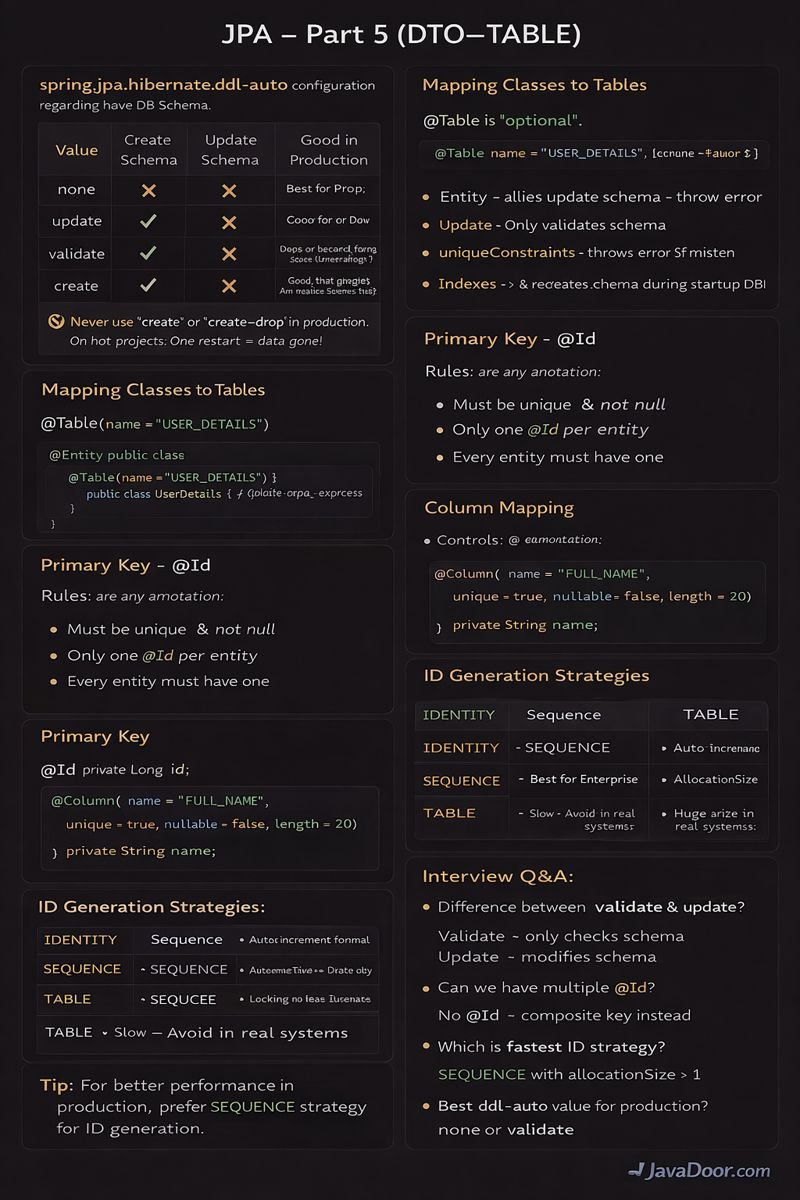
spring.jpa.hibernate.ddl-auto
This property tells Hibernate how to handle DB schema.
| Value | Create | Update | Delete | Use case |
|---|---|---|---|---|
none |
❌ | ❌ | ❌ | Does nothing – Best for Production |
update |
✅ | ✅ | ❌ | Updates schema without deleting data – Good for Dev |
validate |
❌ | ❌ | ❌ | Only validates schema, throws error if mismatch |
create |
✅ | ✅ | ✅ | Drops & recreates tables on startup |
create-drop |
✅ | ✅ | ✅ | Drops on shutdown – Default for H2/in-memory DB |
Extra tip
Never use create or create-drop in production. One restart = data gone.
2. Mapping Class to Table – @Table
@Table is optional.
If not used:
@Entity
public class UserDetails {}
Table becomes → USER_DETAILS (CamelCase → UPPER_SNAKE_CASE)
With @Table
@Table(name="USER_DETAILS", schema="ONBOARDING")
@Entity
public class UserDetails {}
3. Unique Constraints & Indexes
@Table(
  name="USER_DETAILS",
  uniqueConstraints={
     @UniqueConstraint(columnNames="phone"),
     @UniqueConstraint(columnNames={"name","email"})
  },
  indexes={
     @Index(name="idx_phone", columnList="phone"),
     @Index(name="idx_name_email", columnList="name,email")
  }
)
Meaning
phone→ single column uniquename+email→ composite unique- Index improves search performance
4. Column Mapping – @Column
Optional annotation.
@Column(
  name="FULL_NAME",
  unique=true,
  nullable=false,
  length=20
)
private String name;
Controls:
- Column name
- Nullability
- Length
- Uniqueness
5. Primary Key – @Id
Rules:
- Must be unique & not null
- Only one @Id per entity
- Every entity must have one
6. Composite Primary Key
Two approaches:
A) Using @IdClass
@IdClass(UserDetailsCK.class)
@Entity
public class UserDetails {
   @Id private String name;
   @Id private String address;
}
Key class must:
- be public
- implement Serializable
- have no-arg constructor
- override equals & hashCode
B) Using @EmbeddedId
@EmbeddedId
private UserDetailsCK id;
Why equals() & hashCode() needed?
Because Hibernate caching uses HashMap internally.
Without proper keys → cache breaks.
Why Serializable needed?
Composite keys may travel across network in distributed cache.
7. ID Generation Strategies
1. IDENTITY
@GeneratedValue(strategy = GenerationType.IDENTITY)
- Auto-increment by DB
- Simple but DB dependent
- No caching
2. SEQUENCE (Best for Enterprise)
@SequenceGenerator(
  name="user_seq",
  sequenceName="user_seq",
  initialValue=100,
  allocationSize=5
)
@GeneratedValue(strategy=GenerationType.SEQUENCE, generator="user_seq")
How allocationSize works
Hibernate fetches 5 IDs at once:
- Avoids hitting DB every insert
- Huge performance gain
3. TABLE
Uses a separate table to generate IDs
❌ Slow
❌ Locking issues
❌ Avoid in real systems
Why SEQUENCE is better than IDENTITY
| Feature | SEQUENCE | IDENTITY |
|---|---|---|
| Caching | ✅ Yes | ❌ No |
| DB calls | Low | High |
| Multi-table | Yes | No |
| Portability | High | Low |
| Performance | ⭐⭐⭐⭐ | ⭐⭐ |
REAL WORLD BEST PRACTICES (Extra)
| Scenario | Recommended |
|---|---|
| Production DB | SEQUENCE |
| Small project | IDENTITY |
| In-memory DB | create-drop |
| Microservices | SEQUENCE + UUID |
| Bulk inserts | SEQUENCE |
Interview Questions & Answers
Q1. Difference between validate and update?
validate→ only checks schemaupdate→ modifies schema
Q2. Can we have multiple @Id?
No. Use composite key instead.
Q3. Which is fastest ID strategy?
SEQUENCE with allocationSize > 1
Q4. Why not TABLE strategy?
Because it uses:
- extra table
- locking
- multiple DB hits
Q5. What happens if equals/hashCode is wrong?
Hibernate cache will:
- return wrong data
- create duplicates
- cause memory leaks
Q6. Can @Column be skipped?
Yes, JPA generates default columns automatically.
Q7. Best ddl-auto value for production?
none or validate
Q8. Difference between UniqueConstraint and Index?
- Unique → enforces data rule
- Index → improves performance only
One-liner for Interviews (You can memorize)
“In production we should always use SEQUENCE for ID generation and never use create or create-drop for schema management.”