
How does Spring Boot decide the order of auto-configurations?
Spring Boot’s auto-configuration order looks magical from the outside, but internally it follows a very deterministic algorithm based on class loading, conditions, and ordering metadata.
Once you understand this, auto-configuration stops being “black magic” and becomes a rule-based system.
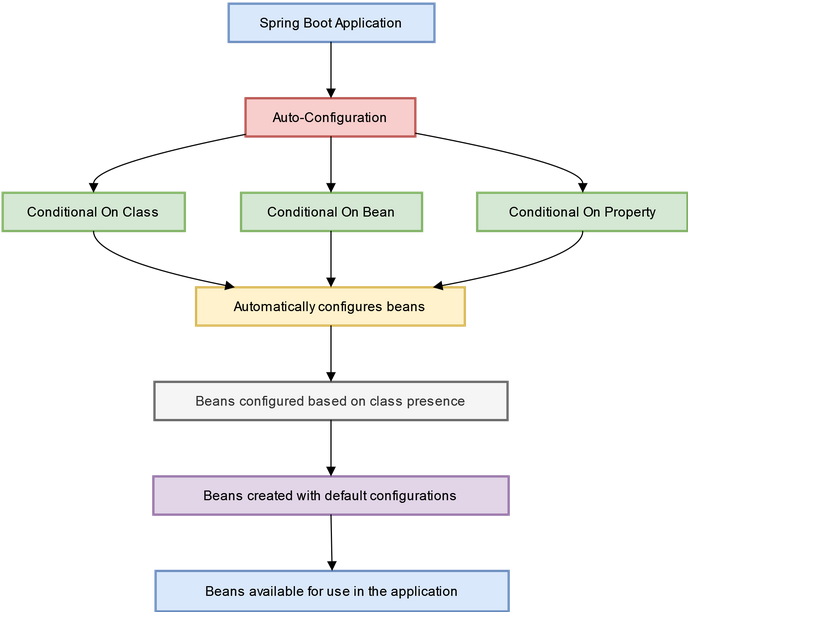
1. The Big Picture
Spring Boot does not randomly load auto-configurations.
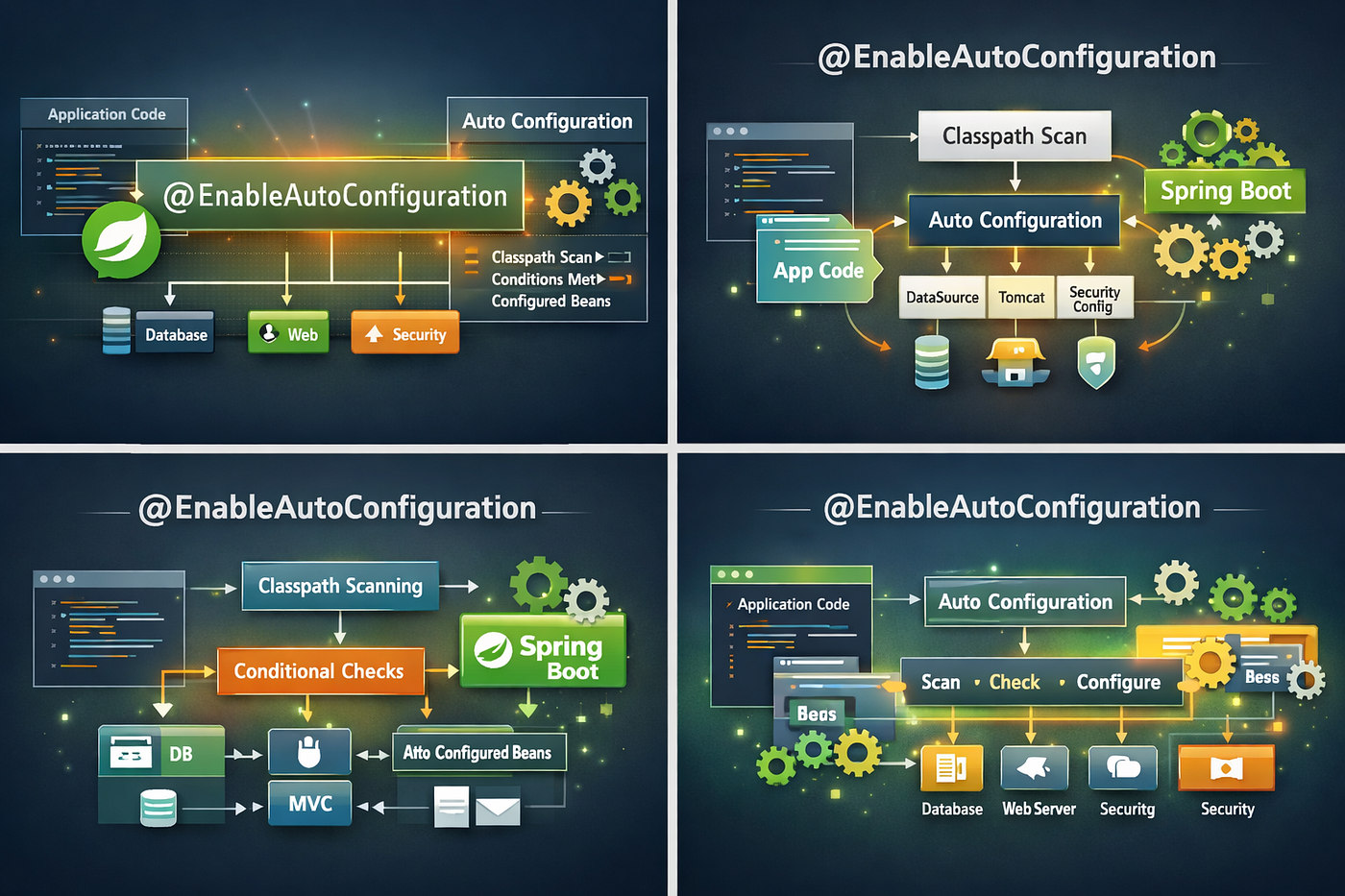
It follows this pipeline:
Read metadata → Sort → Apply conditions → Instantiate
2. Step 1 – Where Auto-Configs Come From
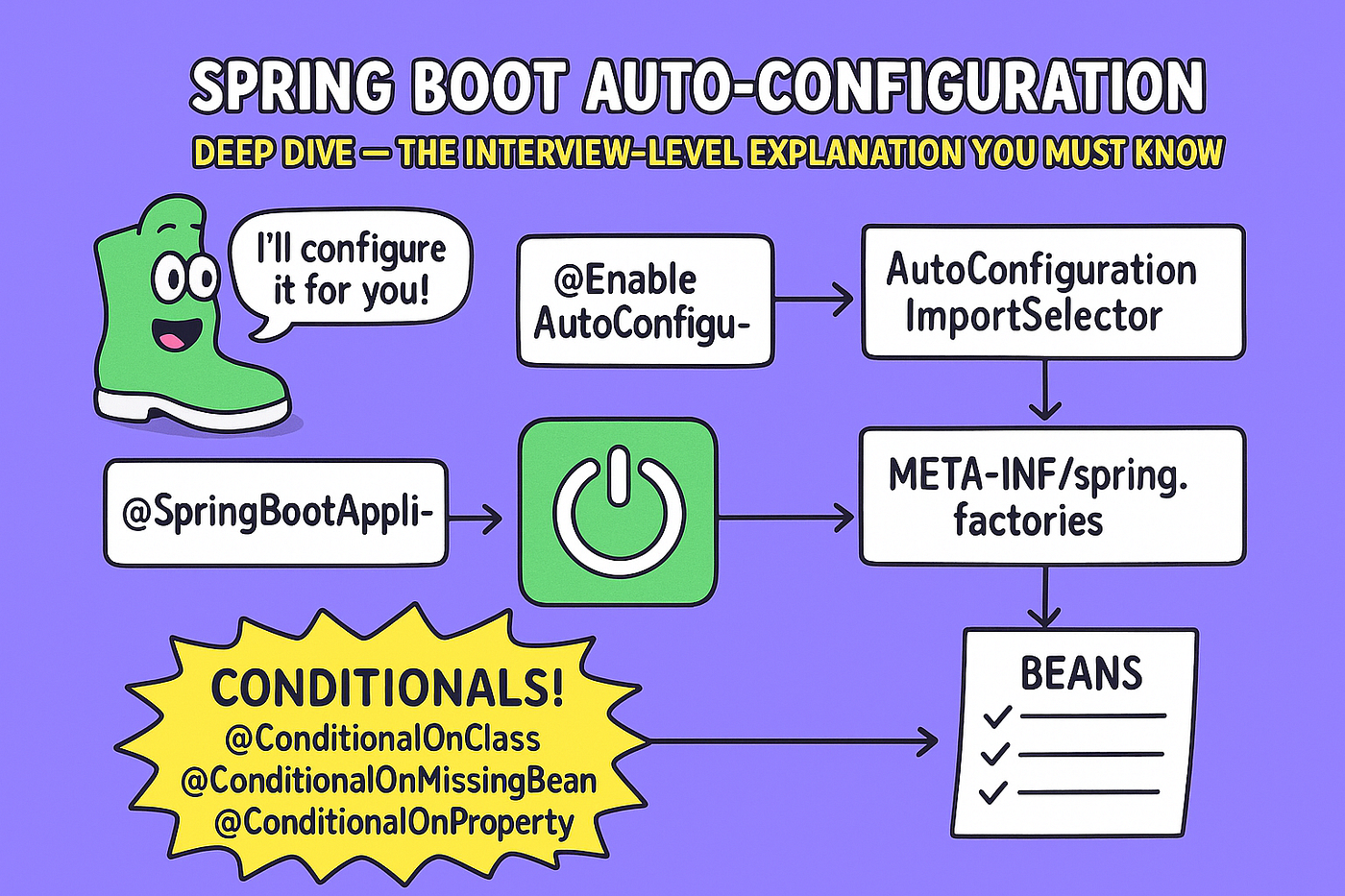
All auto-configurations are discovered from:
META-INF/spring.factories
Inside Spring Boot jars:
org.springframework.boot.autoconfigure.EnableAutoConfiguration=\
DataSourceAutoConfiguration,\
WebMvcAutoConfiguration,\
SecurityAutoConfiguration,...
So initially:
They are just a list of class names.
No beans yet. No logic yet.
3. Step 2 – Ordering Rules (This Is the Core)
Spring applies three layers of ordering:
3.1 Explicit Ordering Annotations
Auto-configs can declare:
@AutoConfigureBefore(X.class)
@AutoConfigureAfter(Y.class)
@AutoConfigureOrder(Ordered.HIGHEST_PRECEDENCE)
This creates a directed graph:
A -> B -> C
Spring topologically sorts this.
If there’s a cycle:
Spring throws an exception and aborts startup.
3.2 @Order (Secondary)
@Order(1)
public class WebMvcAutoConfiguration
Lower number = higher priority.
Used when:
No explicit before/after exists.
3.3 Default Classpath Order
If no ordering info:
JVM classpath loading order is used.
Which means:
- JAR loading order
- OS file system order
This is why:
Some bugs appear only in Docker but not locally.
4. Step 3 – Conditions Decide Whether, Not When
After ordering, Spring checks:
@ConditionalOnClass@ConditionalOnMissingBean@ConditionalOnProperty@ConditionalOnWebApplication
Example:
@ConditionalOnClass(DataSource.class)
public class DataSourceAutoConfiguration
If condition fails:
That auto-config is skipped completely.
But ordering is already decided before this.
5. Step 4 – Bean Registration Order
Inside each auto-config:
@Bean
public DataSource dataSource()
Beans are registered in:
The same order as auto-config classes.
So final sequence is:
AutoConfig order → Bean method order → BeanPostProcessors
6. Why Order Matters So Much
Because of this:
@ConditionalOnMissingBean
If A runs before B:
- B sees bean from A
- B does nothing
If B runs before A:
- B creates default
- A backs off
Same code, totally different system.
7. Real Example: DataSource
Order:
DataSourceAutoConfigurationDataSourceTransactionManagerAutoConfigurationJpaRepositoriesAutoConfiguration
Why?
Because:
JPA needs transaction manager
Transaction manager needs datasource
This is encoded via:
@AutoConfigureAfter(DataSourceAutoConfiguration.class)
8. Debug Mode: See the Real Order
Run with:
--debug
Spring prints:
Positive matches:
-----------------
DataSourceAutoConfiguration matched
WebMvcAutoConfiguration matched

Negative matches:
-----------------
SecurityAutoConfiguration did not match
This shows:
- Final resolved order
- Which ones applied
- Which ones skipped
This is the single most powerful Spring Boot flag.
9. Internally: The Exact Algorithm
Simplified pseudo-flow:
1. Load all EnableAutoConfiguration classes
2. Build dependency graph (before/after)
3. Topological sort
4. Apply @Order
5. Apply classpath fallback
6. Evaluate conditions
7. Register beans
So ordering is resolved before any beans exist.
10. How Custom Auto-Configs Plug In
If you write your own starter:
org.springframework.boot.autoconfigure.EnableAutoConfiguration=\
MyAutoConfiguration
You can control its position:
@AutoConfigureAfter(DataSourceAutoConfiguration.class)
This is how:
- Kafka starter
- Redis starter
- Security starter
All integrate cleanly.
11. The 5 Most Common Ordering Bugs
| Bug | Root cause |
|---|---|
| Bean overridden unexpectedly | Wrong @AutoConfigureAfter |
| Default bean created | Custom config loaded too late |
| Missing transaction | Tx auto-config ran before datasource |
| Security blocking everything | Security auto-config ran too early |
| Works locally, fails in prod | Classpath order difference |
12. Why Spring Boot Rarely Breaks
Because auto-configs are written with:
- Defensive ordering
- Conservative conditions
- Back-off logic
- No hard assumptions
So even with 200 starters:
They usually self-organize correctly.
That’s the real engineering genius.
Interview-Grade Answer (For You, Nimai)
“Spring Boot decides auto-configuration order by first loading all EnableAutoConfiguration classes from spring.factories, then applying @AutoConfigureBefore/@After and @AutoConfigureOrder annotations to build a dependency graph. It topologically sorts this graph, applies @Order as a secondary rule, and finally falls back to classpath order. After ordering, conditional annotations decide which auto-configurations are actually applied.”
This answer puts you in the architect-level bracket.
Final Mental Model
Think of Spring Boot auto-config as:
A dependency-sorted plugin system.
Not magic.
Not reflection chaos.
Just a very well-designed graph solver.