
Why Distributed Transactions Are a Problem?
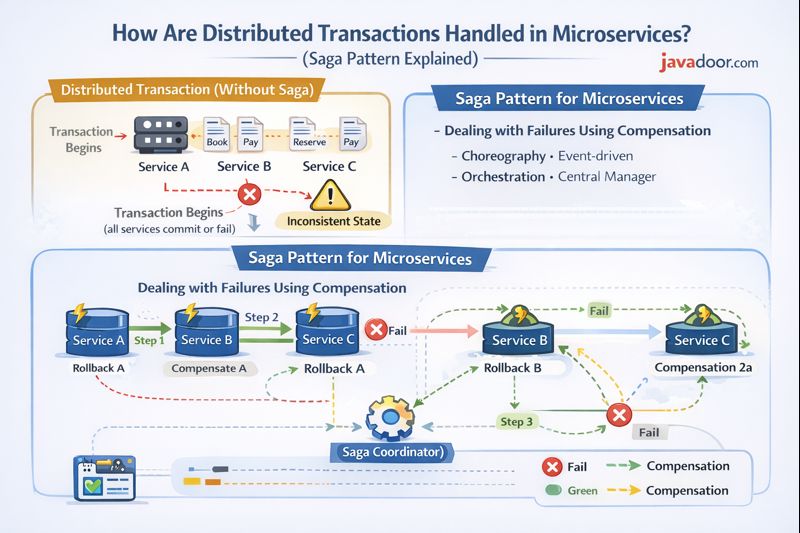
In microservices:
-
Each service has its own database
-
Traditional 2PC (XA transactions) don’t scale well
-
High latency & tight coupling
👉 So we use Saga Pattern.
🔹 What is Saga Pattern?
A Saga is a sequence of local transactions, where:
-
Each service performs its transaction
-
If one fails → compensating actions undo previous steps
🔹 Types of Saga
1️⃣ Choreography-based Saga
-
No central controller
-
Services react to events
📌 Example:
2️⃣ Orchestration-based Saga
-
Central orchestrator controls flow
-
Services respond to commands
📌 Example:
🔹 Example Flow (E-commerce)
-
Order Service → create order
-
Payment Service → deduct money
-
Inventory Service → reduce stock
❌ If inventory fails:
-
Payment Service → refund
-
Order Service → cancel order
🔹 Eventual Consistency
-
Data is not consistent immediately
-
Becomes consistent over time
🔹 Saga vs 2PC
| Aspect | Saga | 2PC |
|---|---|---|
| Coupling | Loose | Tight |
| Performance | High | Slow |
| Scalability | Excellent | Poor |
| Failure Handling | Compensating | Blocking |
🔹 Implementation Tools
-
Kafka / RabbitMQ
-
Spring State Machine
-
Temporal
-
Camunda
🔹 Real-World Use Case
💳 Payment success
📦 Inventory failure
↩ Refund triggered automatically
⭐ Interview One-Liner
“Saga handles distributed transactions by breaking them into local transactions with compensating actions.”
🔹 Follow-Up Questions Interviewers Ask
-
Saga vs Eventual Consistency?
-
How do you handle duplicate events?
-
How do you ensure idempotency?