
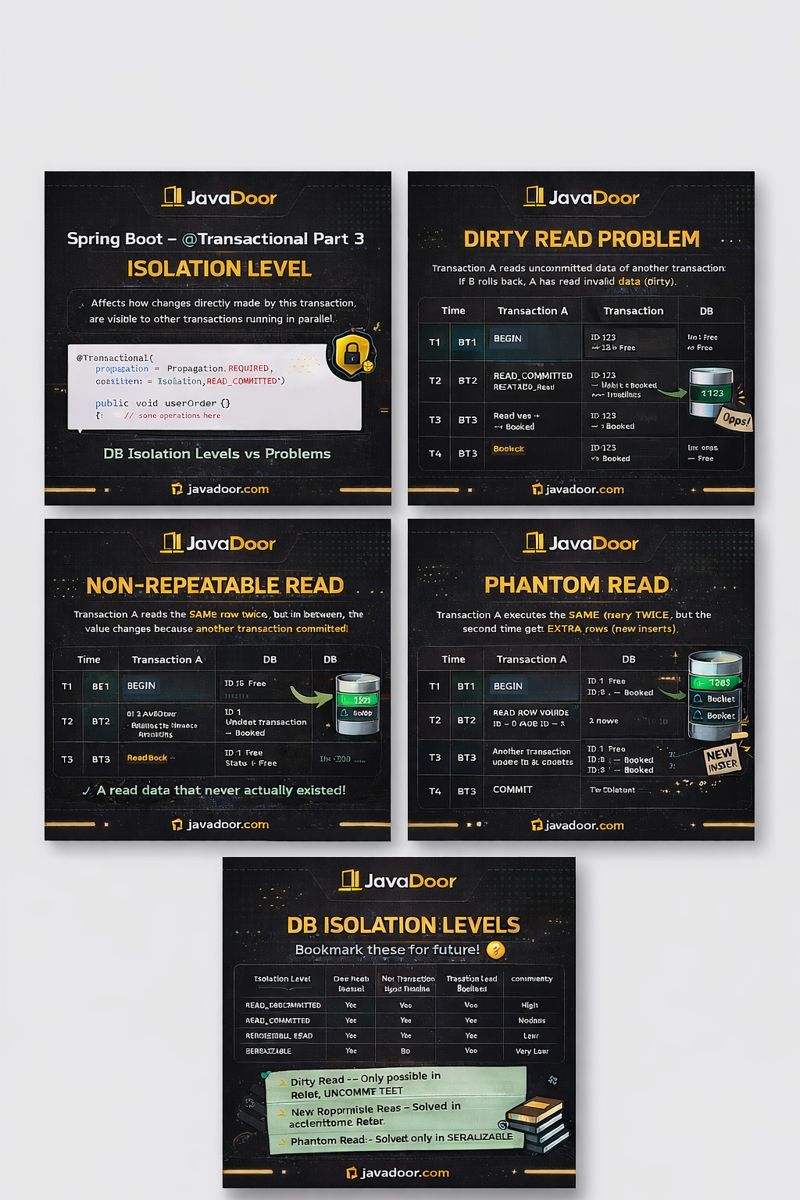
📘 Spring Boot – @Transactional Part 3 (Isolation Level)
🔹 What is Isolation Level?
Isolation level defines how visible one transaction’s changes are to other concurrent transactions.
@Transactional(
    propagation = Propagation.REQUIRED,
    isolation = Isolation.READ_COMMITTED
)
public void userOrder() {
    // some operations here
}
🔹 Isolation Levels vs Problems
| Isolation Level | Dirty Read | Non-Repeatable Read | Phantom Read | Concurrency |
|---|---|---|---|---|
| READ_UNCOMMITTED | Yes | Yes | Yes | High |
| READ_COMMITTED | No | Yes | Yes | Medium |
| REPEATABLE_READ | No | No | Yes | Low |
| SERIALIZABLE | No | No | No | Very Low |
Note:
Most relational DBs use READ_COMMITTED as default (e.g., Oracle, PostgreSQL).
MySQL (InnoDB) default = REPEATABLE_READ.
🔹 Dirty Read Problem
Definition:
Transaction A reads uncommitted data from Transaction B.
If B rolls back, A has read invalid data.
Timeline Example:
| Time | Transaction A | Transaction B | DB Status |
|---|---|---|---|
| T1 | BEGIN | BEGIN | id:123, status: free |
| T2 | Update row id=123 → booked (not committed) | id:123, status: booked | |
| T3 | Read row → booked | id:123, status: booked | |
| T4 | ROLLBACK | id:123, status: free |
👉 A read data that never actually existed!
🔹 Non-Repeatable Read
Definition:
Transaction A reads the same row twice, but gets different values because another transaction committed in between.
Example:
| Time | Transaction A | DB |
|---|---|---|
| T1 | BEGIN | ID=1, status: free |
| T2 | Read ID=1 → free | |
| T3 | Another txn updates & commits → booked | |
| T4 | Read ID=1 → booked | |
| T5 | COMMIT |
🔹 Phantom Read
Definition:
Transaction A runs the same query twice, but second time gets extra rows (new inserts).
Example:
| Time | Transaction A | DB |
|---|---|---|
| T1 | BEGIN | ID=1 free, ID=3 booked |
| T2 | Read where ID>0 and ID<5 → 2 rows | |
| T3 | Another txn inserts ID=2 and commits | |
| T4 | Read same query → 3 rows | |
| T5 | COMMIT |
🔹 DB Locking Types
| Lock Type | Another Shared Lock | Another Exclusive Lock |
|---|---|---|
| Shared Lock (Read) | Yes | No |
| Exclusive Lock (Write) | No | No |
- Shared Lock = READ LOCK
- Exclusive Lock = WRITE LOCK
🔹 Isolation Level Locking Strategy
| Isolation Level | Locking Strategy |
|---|---|
| READ_UNCOMMITTED | No locks for read, no locks for write |
| READ_COMMITTED | Read → shared lock (released immediately), Write → exclusive lock till commit |
| REPEATABLE_READ | Read → shared lock till commit, Write → exclusive lock till commit |
| SERIALIZABLE | Same as REPEATABLE_READ + Range locks to prevent phantom rows |
🧠 Interview Notes (Important)
- Dirty Read → Only possible in
READ_UNCOMMITTED - Non-Repeatable Read → Solved in
REPEATABLE_READ - Phantom Read → Solved only in
SERIALIZABLE - Higher isolation = more locks = less concurrency = slower performance
- In Spring Boot:
@Transactional(isolation = Isolation.REPEATABLE_READ)