
🌱 Spring Boot – @ConditionalOnProperty
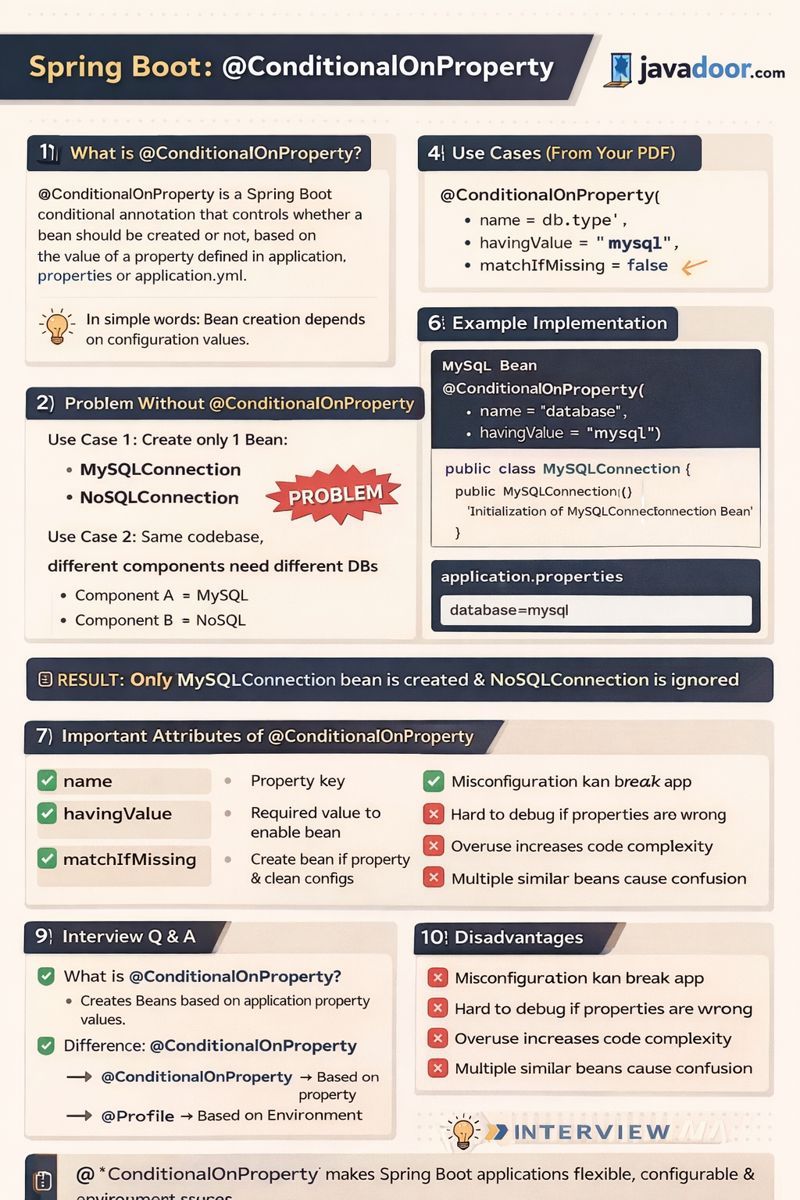
1️⃣ What is @ConditionalOnProperty?
@ConditionalOnProperty is a Spring Boot conditional annotation that controls whether a bean should be created or not, based on the value of a property defined in application.properties or application.yml.
👉 In simple words:
Bean creation depends on configuration values.
2️⃣ Why do we need Conditional Bean Creation?
In real-world applications:
- Different environments need different configurations
- Some features must be enabled/disabled dynamically
- We may want only one implementation active at a time
Spring Boot solves this using conditional annotations, and one of the most commonly used is @ConditionalOnProperty.
3️⃣ Problem Without @ConditionalOnProperty
❌ Default Behavior
If multiple beans exist:
- Spring creates all beans
- May lead to:
- Unnecessary initialization
- Conflicts
- Higher memory usage
- Startup errors
4️⃣ Use Cases (From Your PDF)
✅ Use Case 1
👉 Create only ONE bean
Either:
MySQLConnection- OR
NoSQLConnection
Not both at the same time.
✅ Use Case 2
👉 Same codebase, different components need different DBs
- Component A → MySQL
- Component B → NoSQL
5️⃣ Solution: @ConditionalOnProperty
Spring Boot provides:
@ConditionalOnProperty(
    name = "db.type",
    havingValue = "mysql",
    matchIfMissing = false
)
This tells Spring:
- Create this bean only if property matches
- Otherwise → skip bean creation
6️⃣ Example Implementation
🔹 MySQL Bean
@Component
@ConditionalOnProperty(
    name = "database",
    havingValue = "mysql"
)
public class MySQLConnection {

    public MySQLConnection() {
        System.out.println("Initialization of MySQLConnection Bean");
    }
}
🔹 NoSQL Bean
@Component
@ConditionalOnProperty(
    name = "database",
    havingValue = "nosql"
)
public class NoSQLConnection {

    public NoSQLConnection() {
        System.out.println("Initialization of NoSQLConnection Bean");
    }
}
🔹 application.properties
database=mysql
✔ Result:
- Only MySQLConnection bean is created
- NoSQLConnection is ignored
7️⃣ Important Attributes of @ConditionalOnProperty
| Attribute | Meaning |
|---|---|
name |
Property key |
havingValue |
Required value to enable bean |
matchIfMissing |
Create bean if property is absent |
Example:
@ConditionalOnProperty(
    name = "feature.logging",
    havingValue = "true",
    matchIfMissing = true
)
8️⃣ Real-World Examples (Extra Points)
✅ Enable/Disable:
- Payment gateways (Razorpay / Paytm)
- Cache (Redis ON/OFF)
- Messaging (Kafka / RabbitMQ)
- Feature flags
✅ Environment based:
- Dev → H2 DB
- Prod → MySQL / Oracle
9️⃣ Advantages (From PDF + Added)
✔ Feature toggling
✔ Avoid unnecessary beans
✔ Reduce memory usage
✔ Faster application startup
✔ Clean environment-based configuration
🔟 Disadvantages (From PDF + Added)
❌ Misconfiguration can break app
❌ Hard to debug if properties are wrong
❌ Overuse increases code complexity
❌ Multiple similar beans cause confusion
❌ Difficult to manage in very large projects
1️⃣1️⃣ Best Practices (Added)
✅ Use clear property names
✅ Document properties properly
✅ Avoid overusing conditional beans
✅ Prefer profiles (@Profile) when suitable
✅ Log active configurations at startup
🧠 Interview Questions & Answers
Q1️⃣ What is @ConditionalOnProperty?
Answer:
It is a Spring Boot annotation used to create beans conditionally based on application property values.
Q2️⃣ Why do we need @ConditionalOnProperty?
Answer:
To control bean creation dynamically, avoid unnecessary beans, and support environment-based configurations.
Q3️⃣ Difference between @Profile and @ConditionalOnProperty?
Answer:
@Profile→ Environment based@ConditionalOnProperty→ Property value based (more flexible)
Q4️⃣ What happens if property value does not match?
Answer:
The bean is not created and skipped during application startup.
Q5️⃣ What is matchIfMissing = true?
Answer:
If the property is missing, the bean will still be created.
Q6️⃣ Can multiple beans use the same property?
Answer:
Yes, but different havingValue must be used to avoid conflicts.
Q7️⃣ Is @ConditionalOnProperty evaluated at runtime?
Answer:
No, it is evaluated during application startup.
Q8️⃣ Common mistake with @ConditionalOnProperty?
Answer:
Wrong property key or value in application.properties.
📌 Summary (One-Line)
@ConditionalOnPropertyhelps build flexible, configurable, and environment-aware Spring Boot applications.