
Spring Boot – JPA First Level Cache (Persistence Context)
Core Concept (from PDF)
- First Level Cache = Persistence Context
- It is enabled by default in JPA/Hibernate.
- It is scoped to EntityManager.
- Every EntityManager maintains its own cache.
If an entity is already present in Persistence Context, JPA will not hit the database again.
Flow shown in PDF
1. During Application Startup
JPA creates:
- Database
- Tables automatically (because of
ddl-auto=create)
2. Insert and Read Scenario
Even if you:
- Insert data
- Then read it multiple times
👉 Only one SELECT query goes to DB.
All further reads come from first level cache.
Important Observation (from logs in PDF)
Only one SQL:
select * from user_details where id=1;
After that:
- No SQL
- Data served from memory
Persistence Context Scope
From PDF:
PersistenceContext is associated with EntityManager
So:
- Same HTTP request → Same EntityManager → Cache works
- New request → New EntityManager → Cache lost
EntityManager Example (from PDF)
EntityManager em = emf.createEntityManager();
em.getTransaction().begin();

User u1 = em.find(User.class, 1L);
User u2 = em.find(User.class, 1L);

em.getTransaction().commit();
Output:
- Only one DB hit
- Second
find()uses cache
DispatcherServlet Insight (from PDF)
Spring internally:
- Creates one EntityManager per request
- Injects same instance into:
- Service
- Repository
- DAO
So inside same request:
Cache always works
Extra Notes (Not directly in PDF but important)
1. Cache States of Entity
| State | Meaning |
|---|---|
| New | Not yet persisted |
| Managed | In persistence context |
| Detached | EntityManager closed |
| Removed | Marked for delete |
Only Managed entities are cached.
2. When Cache is Lost?
Cache is cleared when:
- EntityManager is closed
- Transaction ends
- New HTTP request
3. Methods that BYPASS First Level Cache
| Method | Behavior |
|---|---|
clear() |
Clears entire cache |
detach(entity) |
Removes one entity |
refresh(entity) |
Forces DB hit |
| Native query | Bypasses cache |
4. First vs Second Level Cache
| Feature | First Level | Second Level |
|---|---|---|
| Scope | EntityManager | Application |
| Default | Yes | No |
| Memory | Per request | Shared |
| Config needed | No | Yes (Ehcache/Redis) |
Real Interview Q&A
Q1. What is First Level Cache?
Answer:
First level cache is the default cache mechanism in JPA, where entities are stored in the persistence context associated with EntityManager.
Q2. Is first level cache shared?
Answer:
No. It is not shared between EntityManagers.
Q3. When does DB get hit again?
Answer:
When:
- New EntityManager is created
- Entity is detached
- Cache is cleared
- Transaction ends
Q4. Does repository use same EntityManager?
Answer:
Yes. Spring injects the same EntityManager per HTTP request.
Q5. Does save() store in cache?
Answer:
Yes. After save() entity becomes managed and stays in cache.
Q6. Is first level cache configurable?
Answer:
No. It is mandatory and cannot be disabled.
One-Liner for Interview
First level cache is the persistence context of JPA, scoped to EntityManager, and ensures that within the same transaction/request, the same entity is never fetched twice from the database.
Real-World Example (Banking)
In SBI-like systems (your domain 😉):
If a customer record is fetched:
- KYC service reads it
- Loan service reads it
- Risk service reads it
Within same request → only one DB hit
Massive performance gain.
Common Mistake Developers Make
Thinking:
“Hibernate cache is not working”
Reality:
New request = New EntityManager = New cache
So cache was working perfectly.
Bonus Trick (Performance)
Use:
@PersistenceContext
EntityManager em;
Instead of manually creating:
emf.createEntityManager();
Spring then manages lifecycle and caching optimally.
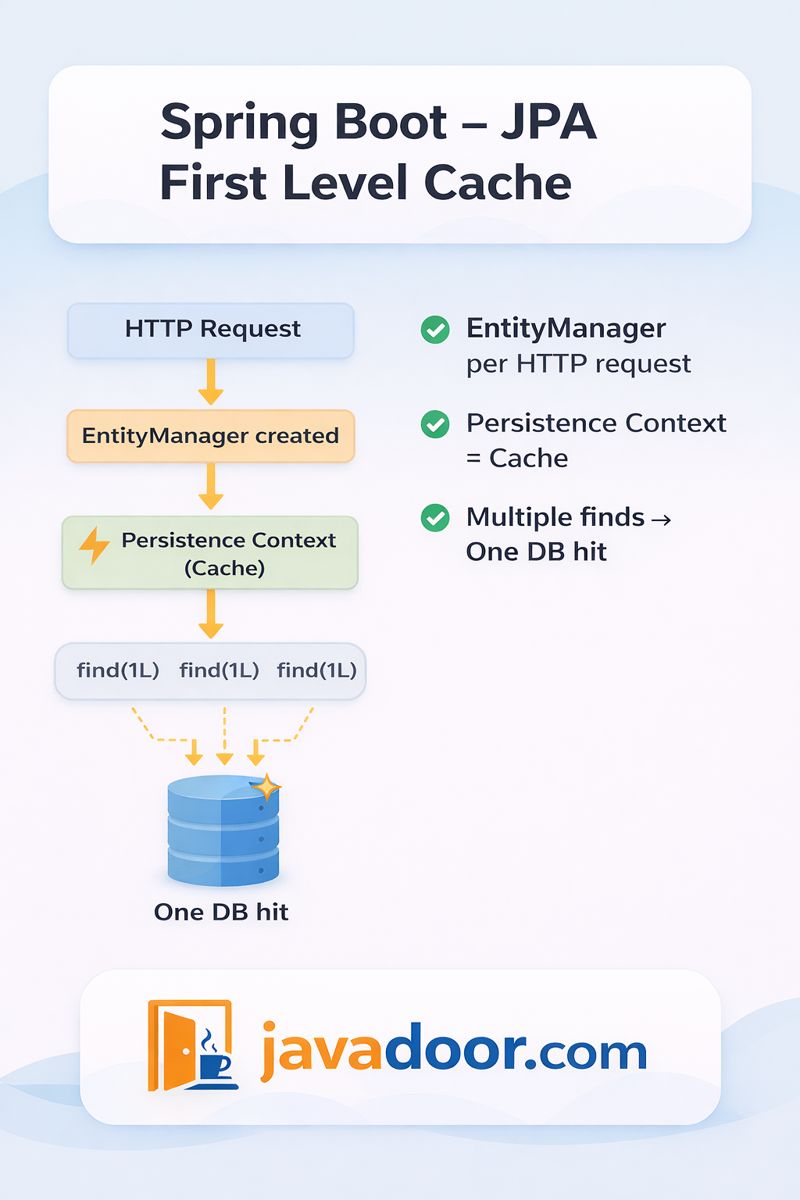
Final Mental Model
HTTP Request
   ↓
EntityManager created
   ↓
Persistence Context (Cache)
   ↓
Multiple find() → One DB hit
   ↓
Request ends → Cache destroyed